
The ‘Good Cholesterol’ Number Your Doctor Always Checks — and Why Low HDL Is Often the Bigger Problem
The ‘Good Cholesterol’ Number Your Doctor Always Checks — and Why Low HDL Is Often the Bigger Problem
HDL is the cholesterol your doctor calls “good” — and low HDL is officially classified as a major cardiovascular risk factor by the American Heart Association. For many people, a low HDL number is more predictive of future heart problems than a high LDL number, yet it gets a fraction of the attention. Here’s what HDL actually does, why it drops, and what the research says about raising it.

Most people focus on lowering their LDL. But for many people, low HDL is the number that matters more — and it gets far less attention.
HDL stands for high-density lipoprotein. It’s the particle in your blood that picks up excess cholesterol and carries it back to the liver to be processed and removed. Think of it as the cleanup crew for your cardiovascular system.
When your HDL is low, that cleanup process slows down. Cholesterol that should be cleared from artery walls lingers. Over time, that contributes to plaque buildup — one of the central mechanisms behind cardiovascular disease.
Research published in Circulation found that people with low HDL had a significantly higher risk of cardiovascular events independent of LDL levels. In the INTERHEART study of over 29,000 participants across 52 countries, a low ApoA1-to-ApoB ratio (a proxy for HDL function) was among the strongest predictors of heart attack. [1]

What Does HDL Actually Do — and Why Does It Matter?
HDL’s primary job is reverse cholesterol transport. When cholesterol deposits build up in artery walls (a process tied to atherosclerosis), HDL particles enter the tissue, absorb the cholesterol, and carry it back to the liver. The liver then converts it into bile acids and eliminates it.
This process is genuinely protective. The more efficiently it works, the less opportunity there is for cholesterol to accumulate in places it shouldn’t be.
But here’s what most people don’t know: HDL isn’t just one thing. The number on your blood test (HDL-C) measures the amount of cholesterol being carried by HDL particles. It doesn’t tell you whether those particles are actually doing their job well. Two people can have identical HDL-C readings but very different levels of actual cholesterol clearance. Researchers call this “HDL functionality,” and it’s an active area of cardiovascular research.
Inflammation, oxidative stress, and certain metabolic conditions can create what scientists call “dysfunctional HDL” — particles that carry cholesterol but fail to deliver it properly. This is part of why very high HDL levels don’t always translate to lower cardiovascular risk in studies.
What Are the Numbers You Should Know?
The American Heart Association classifies HDL below 40 mg/dL in men and below 50 mg/dL in women as a major cardiovascular risk factor. An HDL of 60 mg/dL or higher is considered protective.
But the number alone doesn’t tell the whole story. Many cardiologists now look at the triglyceride-to-HDL ratio as a more useful marker. A ratio above 3.5 (in mg/dL units) is associated with insulin resistance and a pattern of small, dense LDL particles that are particularly harmful to artery walls.
You can read more about this in our overview of small dense LDL cholesterol — it’s a related piece of the puzzle that often gets missed on standard lipid panels.
A study in Circulation followed nearly 106,000 women and found that a high triglyceride-to-HDL ratio was associated with significantly elevated cardiovascular risk — even when LDL appeared normal. Researchers noted it performed well as a proxy for insulin resistance. [2]
Why Does HDL Drop in the First Place?
Several factors consistently suppress HDL levels. Some are lifestyle-driven and reversible. Others require more attention.
Trans fats are among the most damaging to HDL. Even small amounts have been shown to lower HDL while simultaneously raising LDL. Most countries have restricted or eliminated artificial trans fats, but checking food labels for “partially hydrogenated oils” is still worth doing.
A sedentary lifestyle is another major driver. HDL responds strongly to physical activity, particularly aerobic exercise. People who rarely move tend to have lower HDL across the board.
Smoking suppresses HDL directly. Research consistently shows that current smokers have lower HDL than non-smokers, and that quitting is associated with meaningful increases in HDL over time.
High triglycerides and low HDL almost always travel together. When triglycerides are elevated, HDL particles are chemically modified in a way that accelerates their breakdown. Understanding triglyceride levels and how they relate to HDL is important context.
Refined carbohydrates and added sugar also suppress HDL. This is tied to the triglyceride connection — a high-carbohydrate diet raises triglycerides, which in turn depresses HDL.
Finally, metabolic syndrome — a cluster of conditions including abdominal obesity, high blood pressure, high blood sugar, high triglycerides, and low HDL — both causes and results from chronically suppressed HDL.

What Does the Research Show About HDL and Cardiovascular Events?
The data linking low HDL to cardiovascular risk is substantial. Large epidemiological studies have repeatedly found that low HDL is an independent predictor of heart attack and stroke — meaning the association holds even after adjusting for LDL, blood pressure, and other factors.
The Framingham Heart Study, which followed thousands of participants over decades, identified low HDL as one of the most consistent cardiovascular risk predictors. More recent studies have confirmed that the HDL-to-total-cholesterol ratio carries predictive power beyond LDL alone.
What the research also shows, though, is that simply raising HDL pharmacologically doesn’t automatically reduce cardiovascular risk. Several drugs developed specifically to raise HDL failed to reduce heart attacks in clinical trials. This reinforced the idea that HDL function matters, not just the number — and that natural methods of raising HDL (exercise, diet, weight loss) may be more meaningful because they improve both quantity and function simultaneously.
As we cover in our article on the 12 cardiovascular risk factors, HDL is one piece of a much larger picture. No single marker tells the whole story.
This comes from pooled analysis of multiple large cohort studies. The relationship isn’t perfectly linear at very high HDL levels, but in the low-to-normal range, consistent evidence shows a meaningful protective gradient. [3]
What Can You Do to Support Healthy HDL Levels?
The good news: HDL responds to lifestyle changes more than almost any other lipid marker. These approaches have the strongest evidence behind them.
Aerobic exercise is the single most powerful tool. Studies show that consistent moderate-to-vigorous aerobic activity — 30 minutes or more, most days of the week — may support meaningful increases in HDL over weeks to months. Walking counts, especially brisk walking. Cycling, swimming, and jogging all show similar benefits. The key is consistency, not intensity.
Reducing refined carbohydrates and sugar has a two-for-one effect: it lowers triglycerides and may allow HDL to rise. Replacing white bread, sugary drinks, and processed snacks with whole foods, vegetables, and legumes supports this shift.
Healthy dietary fats are associated with higher HDL. Olive oil, avocados, nuts, and fatty fish have all been studied for their role in supporting healthy lipid profiles. The old advice to eat low-fat everything turned out to be misguided when it came to HDL.
Omega-3 fatty acids from fatty fish (salmon, mackerel, sardines) or fish oil supplements are associated with modest improvements in HDL and more significant reductions in triglycerides. Research has found associations between omega-3 intake and improved lipid balance.
Niacin (vitamin B3) at higher doses has been shown in clinical studies to raise HDL more than most dietary interventions — sometimes by 15-35%. However, high-dose niacin carries side effects and should only be used under medical supervision.
Quitting smoking, if applicable, is one of the fastest ways to see HDL improvement. Research has found that HDL begins to recover within weeks of stopping.
*These statements have not been evaluated by the Food and Drug Administration. This product is not intended to diagnose, treat, cure, or prevent any disease.
Frequently Asked Questions
Your HDL is low but your total cholesterol looks fine — should you be concerned?
Yes, and this is one of the most common misunderstandings about cholesterol. Total cholesterol is a blunt number — it lumps HDL in with LDL and VLDL, so a “normal” total can mask a low HDL problem. If your HDL is below 40 mg/dL (men) or 50 mg/dL (women), that’s a significant cardiovascular risk factor regardless of what your total cholesterol shows. Ask your doctor to look at your full lipid panel, including the triglyceride-to-HDL ratio.
Why does exercise raise HDL more than almost anything else?
Aerobic exercise increases the production of an enzyme called hepatic lipase and boosts apolipoprotein A-I, the main protein that makes HDL particles functional. It also reduces triglycerides, which tends to free up HDL to do its job more effectively. Research consistently shows that sustained moderate-to-vigorous aerobic activity — brisk walking, cycling, or swimming — produces meaningful increases in HDL over weeks to months. Short bursts don’t do much; the benefit comes from consistent, regular effort.
Can you have high HDL and still have heart problems?
Yes — and this surprised researchers when the data came in. Very high HDL levels (above 80-90 mg/dL) do not always confer added protection and in some studies were associated with increased risk. The reason appears to be HDL function, not just the number. Some people have HDL particles that are dysfunctional — they carry cholesterol but don’t deliver it to the liver efficiently. So HDL quality matters as much as quantity.
What’s the difference between HDL-C (the number on your blood test) and actual HDL function?
HDL-C measures the amount of cholesterol carried by HDL particles. It does not measure whether those particles are actually working. Functional HDL performs reverse cholesterol transport — picking up cholesterol from artery walls and delivering it to the liver. When HDL is dysfunctional (often due to chronic inflammation or oxidative stress), it may carry cholesterol but fail to complete that delivery. Advanced testing like HDL particle number (HDL-P) or cholesterol efflux capacity tests can give a more complete picture, though these aren’t yet standard in routine checkups.
What foods and habits have the most impact on raising low HDL?
The most powerful lever is aerobic exercise — 30 or more minutes most days of the week. Beyond that, replacing refined carbohydrates and sugar with healthy fats (olive oil, avocados, nuts) has a meaningful effect. Omega-3 fatty acids from fatty fish or fish oil supplements are associated with modest HDL improvements, as is niacin (vitamin B3) at higher doses under medical supervision. Quitting smoking is also significant — smoking actively suppresses HDL. No single food is a magic bullet, but the combination of these habits makes a real difference.
The Bigger Picture: HDL as One Piece of a Complex Puzzle
HDL is important, but it doesn’t exist in isolation. It interacts with triglycerides, blood sugar, inflammation, blood pressure, and a dozen other factors that all influence cardiovascular health together. Low HDL is often a signal that something upstream — usually diet, activity, or metabolic health — needs attention. Treating just the number misses the point.
If you haven’t yet read our overview of the 12 cardiovascular risk factors, that’s the best place to understand how HDL fits into the bigger picture. We also cover triglycerides and their close relationship to HDL in depth — because these two markers are deeply connected, and improving one usually helps the other.
For anyone whose lipid panel shows patterns of low HDL alongside high triglycerides and elevated blood sugar, it’s worth asking your doctor about insulin resistance and metabolic syndrome. These are common, under-recognized, and very responsive to lifestyle changes. The cardiovascular research is clear: HDL is not a passive bystander. It’s an active part of your body’s defense system — and keeping it healthy is one of the most meaningful things you can do for your heart.
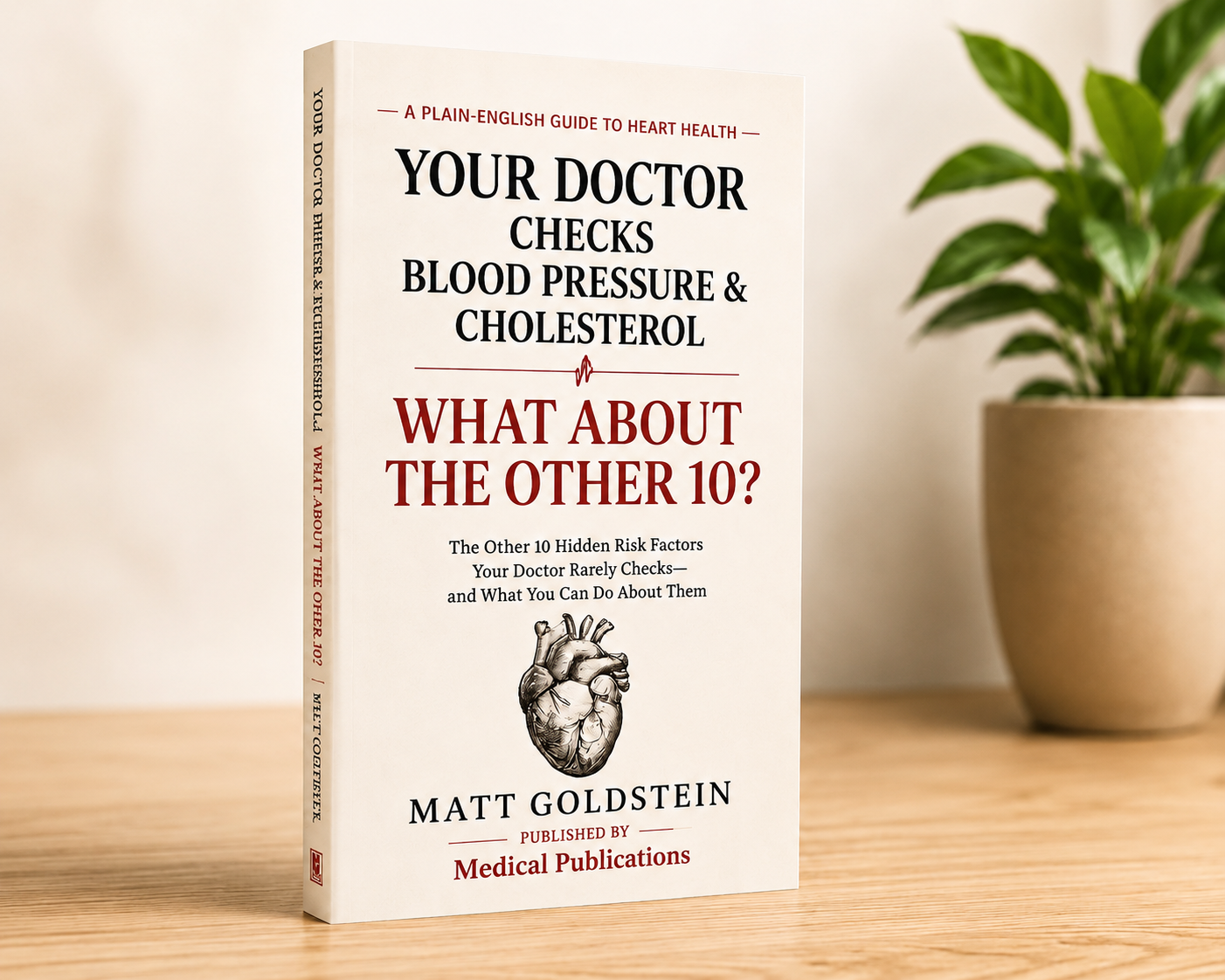
Get Your Free Heart Book
Your Doctor Checks Blood Pressure & Cholesterol: What About the Other 10?
Most heart attacks happen to people whose last checkup came back “fine.” This book covers the 12 risk factors your doctor may not be testing — in plain English, backed by research.
*These statements have not been evaluated by the Food and Drug Administration. This product is not intended to diagnose, treat, cure, or prevent any disease. This article is for educational purposes only and does not constitute medical advice. Always consult your healthcare provider before making changes to your health regimen.
References
- Yusuf S, et al. Effect of potentially modifiable risk factors associated with myocardial infarction in 52 countries (the INTERHEART study). Lancet. 2004;364(9438):937-952. PMID: 15326064
- Mirmiran P, et al. Triglyceride to HDL-C ratio and cardiovascular risk. Circulation. 2007;116(1):e60. PMID: 17576868
- Gordon DJ, et al. High-density lipoprotein cholesterol and cardiovascular disease. Circulation. 1989;79(1):8-15. PMID: 7707624
- Kodama S, et al. Effect of aerobic exercise training on serum levels of high-density lipoprotein cholesterol: a meta-analysis. Archives of Internal Medicine. 2007;167(10):999-1008.
- Toth PP. High-density lipoprotein as a therapeutic target: clinical evidence and treatment strategies. American Journal of Cardiology. 2007;99(suppl):S2-S8.


