
What Is ApoB and Why Cardiologists Now Consider It a Better Test Than LDL
What Is ApoB and Why Cardiologists Now Consider It a Better Test Than LDL
There’s a cholesterol-related number that most standard blood panels don’t report. Cardiologists are increasingly calling it a better predictor of heart events than LDL. It’s called ApoB, and understanding it could give you a clearer picture of your actual cardiovascular risk.
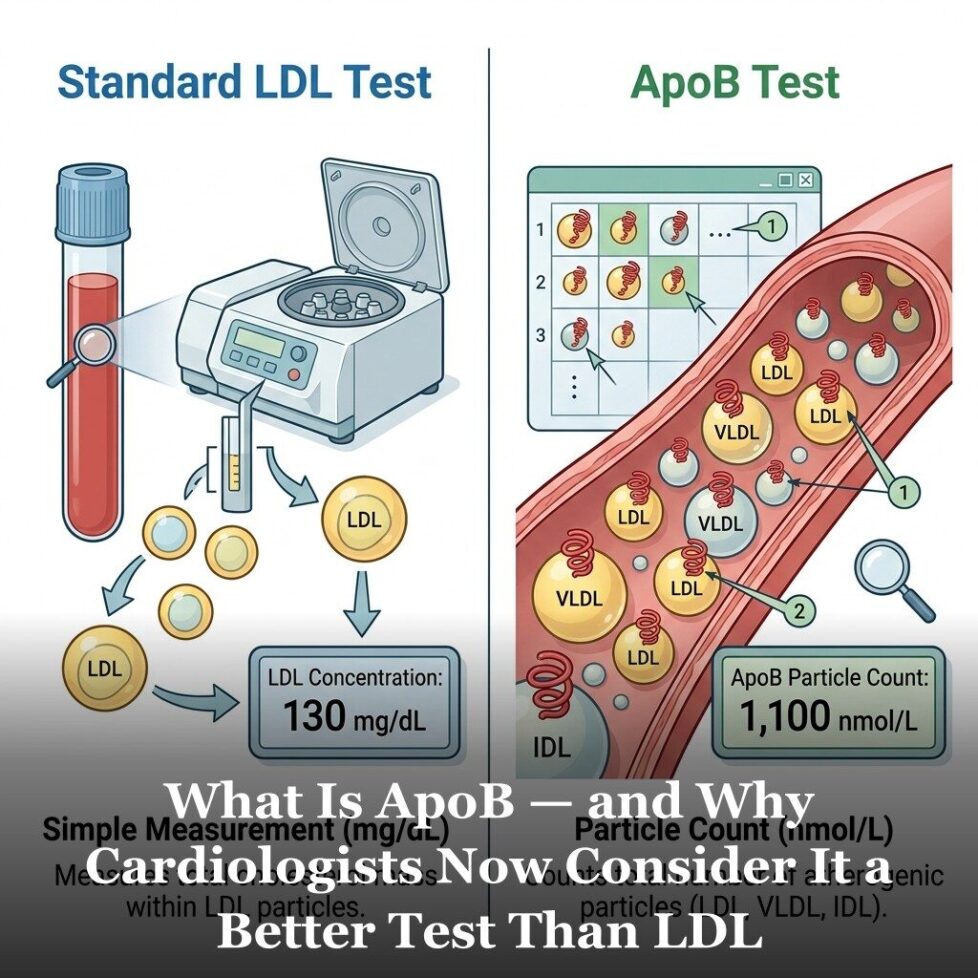
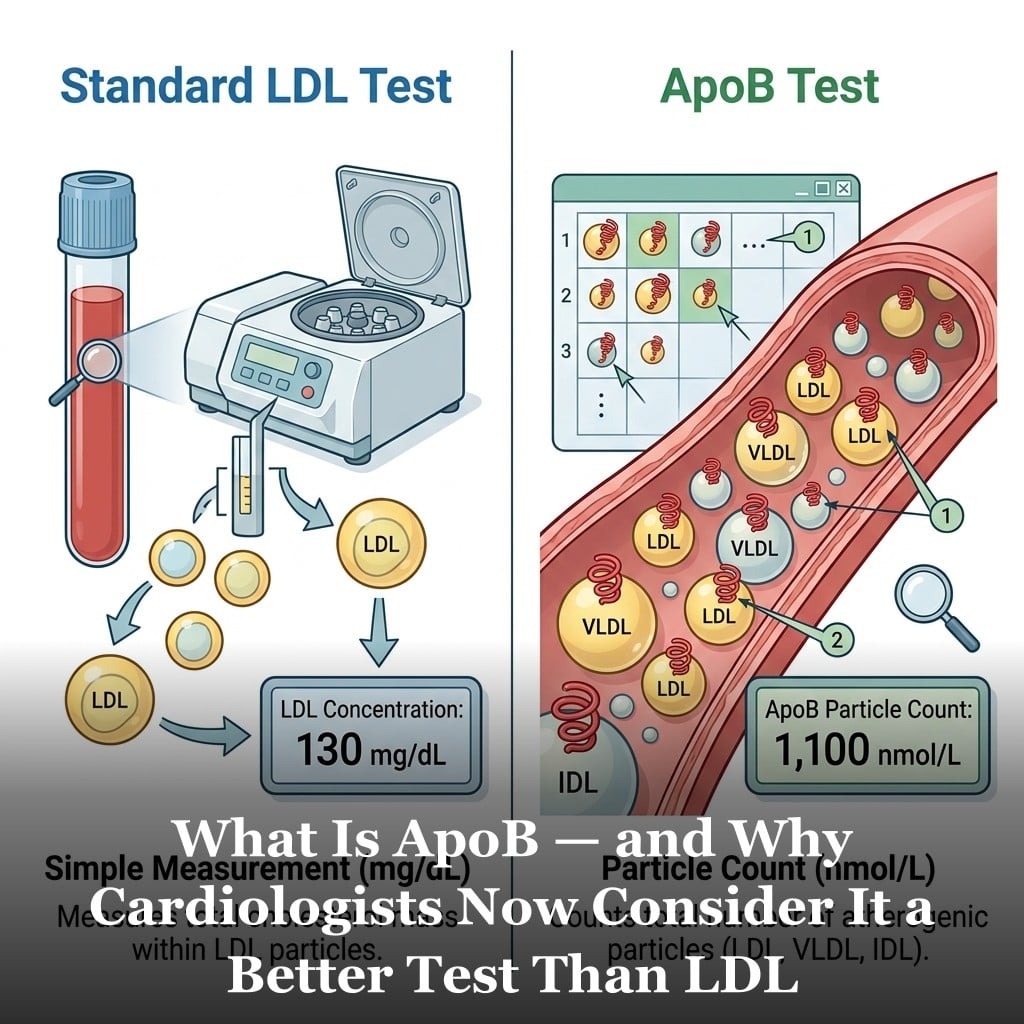
The basic idea is straightforward. Every LDL particle in your bloodstream carries exactly one ApoB protein on its surface. That means measuring ApoB gives you a direct count of the LDL particles that can penetrate artery walls. It’s a more direct measure than LDL cholesterol, which only tells you how much cholesterol those particles are carrying.
Some people have low LDL cholesterol but a high number of particles. Their standard test looks fine. But their actual particle burden is elevated. ApoB catches what the standard test misses.
What Is the ApoB Protein?
ApoB is short for apolipoprotein B-100. It’s a structural protein that sits on the surface of LDL particles and several other atherogenic lipoproteins, including VLDL and IDL. Its primary job is to help the particle bind to receptors in the liver so it can be cleared from circulation.
The key fact is that each LDL particle carries exactly one ApoB molecule. This one-to-one relationship is what makes ApoB so useful as a test. When you measure ApoB, you’re directly counting the number of artery-penetrating lipoprotein particles in your blood.
This is fundamentally different from LDL-C, which measures the total cholesterol inside all LDL particles combined. Two people can have identical LDL-C readings but very different ApoB readings, depending on the number and size of their LDL particles.
How ApoB Compares to Standard LDL Testing
Multiple large studies and meta-analyses have compared ApoB to LDL-C as predictors of cardiovascular events. Several major findings have emerged.
First, in patients where ApoB and LDL-C give discordant results — where one is elevated but the other is not — ApoB tends to be the stronger predictor. This is especially true in people with insulin resistance, metabolic syndrome, or elevated triglycerides.
Second, the European Society of Cardiology and several other major cardiovascular organizations now recommend ApoB as a primary or secondary risk marker alongside traditional cholesterol testing. The case for ApoB has built steadily over the past two decades.
Third, ApoB is a single straightforward blood test. It doesn’t require the same fasting conditions as a standard lipid panel. And it’s less expensive than full LDL particle counting via NMR.
For a broader look at how cholesterol testing fits into overall heart health, the 12 cardiovascular risk factors article gives you the full framework.
When to Ask Your Doctor About an ApoB Test
ApoB testing is most useful in specific clinical situations. It tends to add the most information for people whose standard lipid panel shows borderline or conflicting results.
If your LDL-C is in the normal range but you have elevated triglycerides, low HDL, or other signs of insulin resistance, ApoB can help clarify whether your actual particle burden is a concern. If you have a family history of early heart disease despite normal cholesterol, ApoB is a reasonable next step.
It’s also worth knowing if you’re on a statin that is lowering your LDL-C. Statins reduce LDL-C but their effect on particle number can differ from their effect on cholesterol levels. ApoB gives a more complete picture of how well treatment is working for some patients.
Asking your doctor for an ApoB test is a simple, direct request. If your doctor is familiar with current cardiology guidelines, it should be a straightforward conversation. If they aren’t familiar with ApoB as a risk marker, you can reference the ESC guidelines or ask for a referral to a cardiologist for a fuller lipid evaluation.
Also worth understanding: the LDL particle size question we covered in the previous article and the ApoB question are closely related. ApoB is the practical way to answer the particle count question without ordering a full NMR panel.

Frequently Asked Questions
Is ApoB part of a standard blood panel?
Not typically. Standard lipid panels include total cholesterol, LDL-C, HDL-C, and triglycerides. ApoB is a separate add-on test that your doctor needs to specifically order. It’s increasingly available through standard labs including Quest and LabCorp.
What is a healthy ApoB level?
Most guidelines consider ApoB below 80 mg/dL to be optimal for people at average cardiovascular risk, and below 65-70 mg/dL for people at higher risk. However, targets should be interpreted in the context of your overall risk profile. Your doctor can help you understand what the number means for your specific situation.
Can lifestyle changes lower ApoB?
Yes. Strategies that reduce LDL particle number — reducing refined carbohydrates, increasing physical activity, improving insulin sensitivity, and sometimes using statins or other lipid-lowering therapies — also tend to reduce ApoB. The changes that improve metabolic health broadly tend to improve ApoB as well.
Is ApoB the same as LDL particle number?
They measure related but slightly different things. ApoB counts all atherogenic particles including VLDL and IDL, not just LDL. LDL-P (measured by NMR) specifically counts LDL particles. In practice, the two measures correlate strongly and for most clinical purposes they provide similar information. ApoB is simpler and less expensive to measure.
Get Your Free Heart Book
Your Doctor Checks Blood Pressure & Cholesterol: What About the Other 10?
Most heart attacks happen to people whose last checkup came back “fine.” This book covers the 12 risk factors your doctor may not be testing — in plain English, backed by research.
Get the Free Book →* These statements have not been evaluated by the Food and Drug Administration. This product is not intended to diagnose, treat, cure, or prevent any disease.


