
What Is Nitric Oxide and Why Scientists Call It the Miracle Molecule for Your Arteries
What Is Nitric Oxide and Why Scientists Call It the Miracle Molecule for Your Arteries
In 1998, three American scientists won the Nobel Prize in Physiology or Medicine for discovering how a single gas molecule keeps your arteries healthy. The molecule is nitric oxide (NO), and their discovery fundamentally changed how scientists understand cardiovascular disease. The Nobel committee called it “a signal molecule in the cardiovascular system.”
Nitric oxide is produced by the cells lining your blood vessels and it signals the surrounding muscle tissue to relax. This simple mechanism has profound implications for blood pressure, blood flow, inflammation, and arterial health. And production of this molecule declines significantly with age.
What Nitric Oxide Is and How It’s Made
Nitric oxide is not the same as nitrous oxide (laughing gas) or nitrogen dioxide (air pollutant). It’s a diatomic molecule — two atoms, one nitrogen and one oxygen — produced naturally in the human body through several pathways.
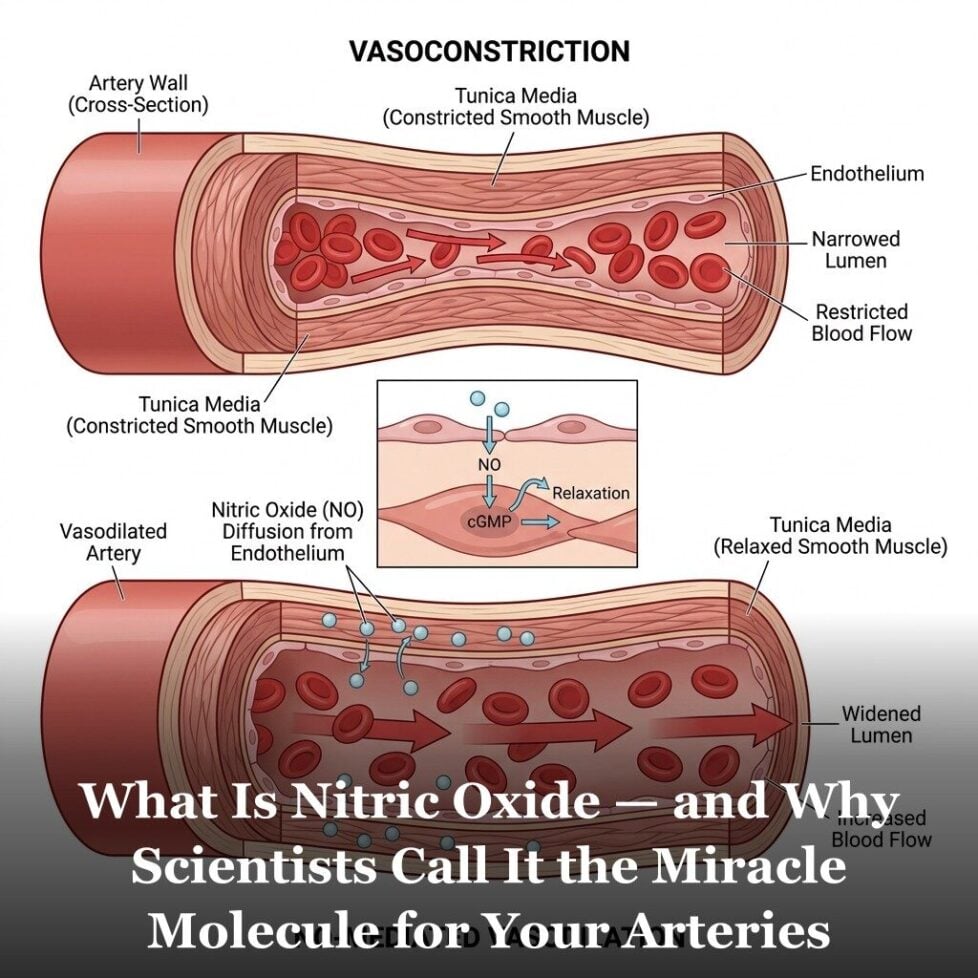
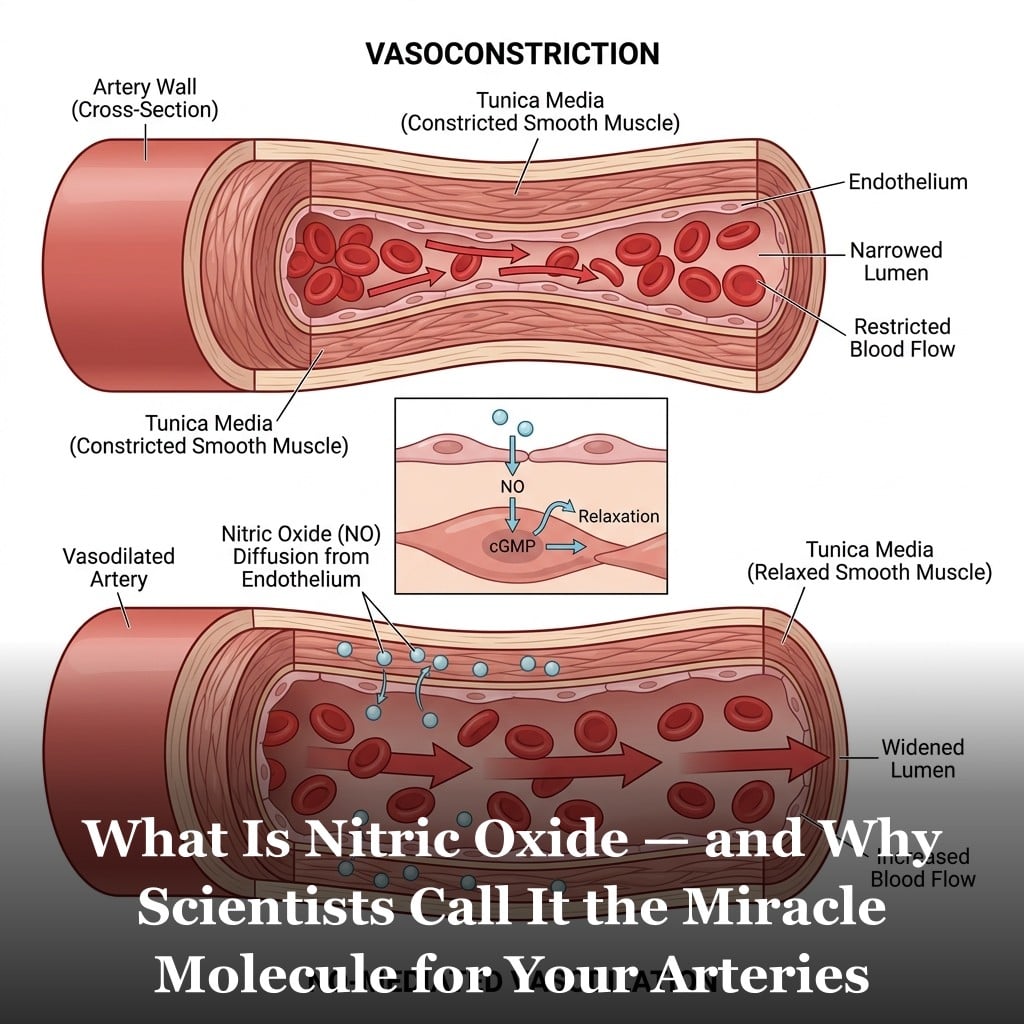
The primary pathway involves endothelial cells — the thin layer of cells lining the inside of every blood vessel. These cells contain an enzyme called endothelial nitric oxide synthase (eNOS). When eNOS is activated, it converts the amino acid L-arginine into nitric oxide, which then diffuses into the surrounding smooth muscle cells.
In smooth muscle cells, nitric oxide activates an enzyme that produces a signaling molecule called cGMP. cGMP tells the smooth muscle cells to relax. When smooth muscle relaxes, the blood vessel wall expands — a process called vasodilation. This widens the vessel, reduces resistance to blood flow, and helps maintain healthy blood pressure levels already within normal range.
What Nitric Oxide Does in the Cardiovascular System
Nitric oxide’s effects on the cardiovascular system extend well beyond just widening blood vessels. It plays multiple protective roles in arterial health.
Vasodilation and blood pressure support. This is the most well-known effect. By relaxing smooth muscle, NO supports healthy blood pressure levels already within normal range and helps arteries respond appropriately to changes in blood flow demand — during exercise, stress, or postural changes.
Reducing platelet aggregation. Nitric oxide inhibits the tendency of platelets to clump together and form clots on arterial walls. This effect helps maintain normal blood flow and supports healthy vascular function.
Anti-inflammatory effects in arterial walls. NO inhibits the adhesion of white blood cells to blood vessel walls — a key early step in the process that leads to arterial plaque development. Endothelial cells with healthy NO production maintain a less “sticky” surface that resists inflammation.
Antioxidant protection. Nitric oxide can scavenge certain damaging free radicals, providing some protection against oxidative stress in the vascular system.
All of these effects work together. A blood vessel with healthy endothelial function and robust NO production is more flexible, less prone to inflammation, and better at maintaining appropriate blood flow than one with impaired NO production.
Why Nitric Oxide Matters for Everyday Cardiovascular Health
The practical significance of nitric oxide comes down to this: your blood vessels are only as healthy as their ability to produce and use it. An arterial system with robust NO production is more flexible, maintains healthier pressure, and is more resistant to the early steps of plaque development.
But NO production declines with age. By age 70, most people produce significantly less nitric oxide than they did at 40. This decline is one of the reasons arterial stiffness increases with age, why blood pressure tends to rise, and why cardiovascular risk climbs as we get older.
The good news is that NO production is influenced by factors within your control. Regular physical exercise is one of the most powerful stimulators of eNOS activity. Dietary nitrates (from vegetables like beets, arugula, and spinach) support a separate NO production pathway. Certain amino acids — L-arginine and L-citrulline — are precursors to NO production through the enzymatic pathway. We’ll cover each of these in the articles that follow in this series.
For the full picture of how nitric oxide fits into the 12 cardiovascular risk factors, see the 12 cardiovascular risk factors. For how arterial stiffness connects to NO decline, the arterial stiffness article provides useful context.
Frequently Asked Questions
Is nitric oxide the same as nitrogen dioxide?
No. Nitric oxide (NO) is a single nitrogen atom bonded to a single oxygen atom. Nitrogen dioxide (NO2) is a pollutant found in vehicle exhaust. Nitrous oxide (N2O) is the anesthetic gas used in dentistry. Despite similar names, these are completely different molecules with completely different effects. The nitric oxide your body produces is a beneficial signaling molecule, not a pollutant.
How does the body make nitric oxide?
The body makes nitric oxide through two main pathways. The enzymatic pathway uses the enzyme eNOS to convert L-arginine into nitric oxide inside endothelial cells. The nitrate-nitrite-NO pathway uses dietary nitrates (from vegetables) that oral bacteria convert to nitrite, which tissues then convert to nitric oxide. Both pathways are active in the body and can supplement each other.
Does nitric oxide actually get into the bloodstream as a gas?
Nitric oxide acts primarily as a local signaling molecule. It’s produced in endothelial cells, diffuses a short distance into the adjacent smooth muscle cells, and is rapidly inactivated before it can travel far. It doesn’t circulate through the bloodstream the way hormones do. Its effects are essentially local — it signals the immediately adjacent cells to relax. This is why sustained production by healthy endothelial cells matters so much.
Can supplements boost nitric oxide production?
Certain nutrients can support the pathways that produce nitric oxide. L-arginine is the direct substrate for the enzymatic NO pathway. L-citrulline converts to L-arginine in the kidneys and may actually be more effective than L-arginine supplements for sustaining NO production. Dietary nitrates from beets and leafy greens support the nitrate-nitrite-NO pathway. These statements have not been evaluated by the FDA.
Get Your Free Heart Book
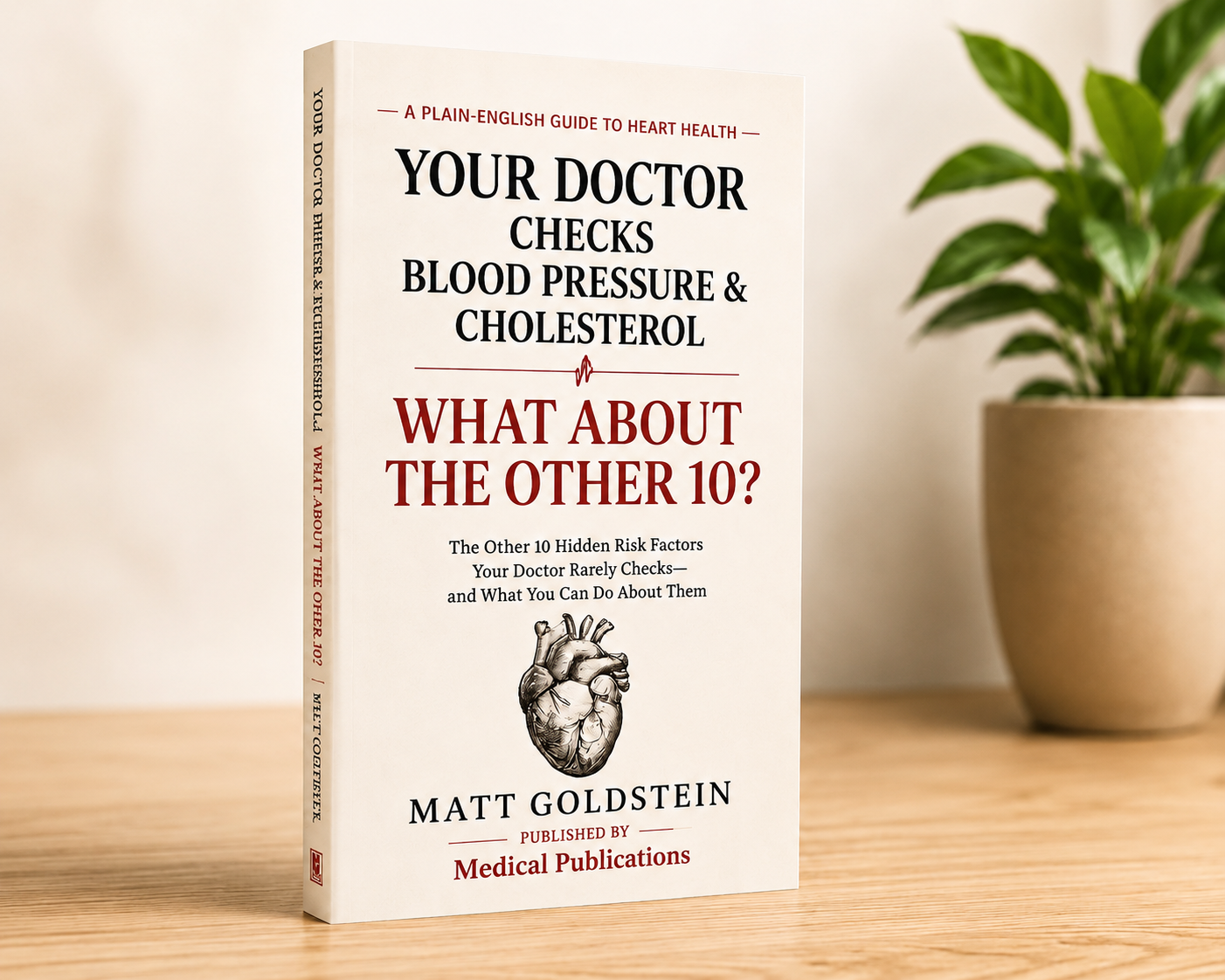
Your Doctor Checks Blood Pressure & Cholesterol: What About the Other 10?
Most heart attacks happen to people whose last checkup came back “fine.” This book covers the 12 risk factors your doctor may not be testing — in plain English, backed by research.
Get the Free Book →* These statements have not been evaluated by the Food and Drug Administration. This product is not intended to diagnose, treat, cure, or prevent any disease.


