

When to See a Cardiologist — Even If You Feel Fine

Most people make an appointment with a cardiologist after something goes wrong. Chest pain. An abnormal EKG. A scare at a routine checkup.
That’s the wrong time.
Not because the appointment doesn’t matter then — it absolutely does. But because by the time you have symptoms, cardiovascular disease has typically been developing for years. Sometimes decades. The symptoms are the end of a long process, not the beginning.
A 2025 study published in the European Heart Journal analyzed more than 4.6 million patients and found that roughly half of heart attack victims had no documented symptoms prior to their event.1 No chest pain. No shortness of breath. Nothing on the record.
The people who most need a cardiologist often have no reason to think they do.
Why Waiting for Symptoms Is the Wrong Strategy
Standard medical care is organized around symptoms. You feel something, you call the doctor, the doctor investigates. It’s a reasonable system for most conditions.
Cardiovascular disease doesn’t follow that pattern.
Atherosclerosis — the buildup of plaque inside artery walls — can progress for twenty years without producing a single noticeable symptom. Blood pressure can be elevated for a decade before causing damage you’d feel. Insulin resistance quietly raises cardiovascular risk long before blood sugar crosses into the diabetic range.
The cardiovascular system is built to compensate. Your body reroutes blood flow, adapts to rising pressure, manages around partial blockages. This is remarkable — and it’s also the reason so many first cardiac events happen without warning.
The INTERHEART study, which analyzed more than 15,000 heart attack cases across 52 countries, found that nine modifiable risk factors accounted for over 90% of the population-attributable risk of a first heart attack.2 Most of those factors can be measured. Most can be addressed. But only if you measure them first.
Who Should See a Cardiologist Before Symptoms Develop
The answer is broader than most people assume. Below are the situations where a preventive cardiology visit makes clear sense — not because something is wrong, but because knowing where you stand is information you can act on.
You have a family history of early heart disease. If a parent or sibling had a heart attack, stroke, or significant cardiovascular event before age 60, your risk is meaningfully elevated independent of your own labs, weight, or lifestyle. Some of that risk is genetic — Lp(a) levels, for example, are roughly 90% determined by genetics and are rarely tested in standard care. A preventive cardiologist can evaluate what your family history actually means for you specifically, not just statistically.
Your standard labs are “normal” — but incomplete. A standard lipid panel checks total cholesterol, LDL, HDL, and triglycerides. That covers two of the twelve cardiovascular risk factors research identifies as meaningful. It doesn’t measure LDL particle size, homocysteine, Lp(a), high-sensitivity CRP, fasting insulin, or RBC magnesium. People with perfectly normal standard panels have heart attacks. “Normal on an incomplete test” is not the same as “low risk.”
You’re over 45 (men) or 55 (women). Cardiovascular risk increases with age, and the post-menopause acceleration in women is significant and often underappreciated. A baseline evaluation in your mid-40s gives you reference points to track over time — and catches anything that needs attention while options are still broad.
You have one or more established risk factors. High blood pressure, type 2 diabetes, obesity, physical inactivity, and smoking all increase cardiovascular risk substantially. Having more than one multiplies it. These aren’t reasons to panic — they’re reasons to get a complete picture.
You’re currently on a statin. Statins are effective at reducing LDL cholesterol. They’re also well-documented to deplete CoQ10, a nutrient the heart muscle depends on for energy production.3 Standard follow-up care after starting a statin often doesn’t include CoQ10 monitoring, B-vitamin levels, or homocysteine. A preventive cardiologist is more likely to look at the full picture.
You’ve had elevated readings that “came back to normal.” Blood pressure that was elevated and then normalized, cholesterol that fluctuates near the borderline, a pre-diabetic blood sugar from three years ago — these aren’t resolved issues. They’re patterns worth tracking.
You have no risk factors and want to keep it that way. A coronary artery calcium (CAC) scan in your late 40s is one of the most useful tests in preventive cardiology. It reveals whether calcified plaque has begun accumulating in your arteries — and a score of zero at the right age is genuinely reassuring in a way that standard blood tests can’t provide.4 Many people with no apparent risk factors turn out to have significant calcium scores. Some with multiple risk factors have a score of zero. You don’t know without looking.
What a Preventive Cardiologist Actually Evaluates
A standard checkup with your primary care physician will typically cover blood pressure, total cholesterol, blood sugar, and weight. That’s a useful snapshot — but it’s two data points out of twelve.
A preventive cardiologist is trained to evaluate the full landscape. A thorough evaluation might include:
- LDL particle size (NMR Lipoprofile or sdLDL test) — particle type is a better predictor of risk than LDL number alone
- Lipoprotein(a) — a genetic risk factor present in roughly 20% of the population, rarely included in standard panels
- Homocysteine — elevated levels are associated with increased arterial wall damage and cardiovascular risk5
- High-sensitivity CRP (hs-CRP) — a marker of systemic inflammation, one of the primary drivers of plaque instability6
- Fasting insulin — a more sensitive early indicator of metabolic risk than fasting glucose
- RBC magnesium — the serum magnesium test most standard labs run misses most deficiencies; RBC testing is more accurate
- Coronary artery calcium (CAC) scoring — non-invasive imaging that reveals calcified plaque in your arteries
None of these are exotic or hard to access. They’re available at most labs. They’re simply not part of a standard workup.
Questions Worth Bringing to Your Next Appointment
Ask your doctor or cardiologist:
☐ “Has my Lp(a) ever been tested?”
☐ “Can we look at LDL particle size, not just total LDL?”
☐ “Would a CAC scan be appropriate given my age and history?”
☐ “Can we add homocysteine and hs-CRP to my next blood draw?”
☐ “When you test my magnesium, are you running serum or RBC?”
☐ “Which of the twelve cardiovascular risk factors have we actually tested for?”
Good doctors welcome these questions. If yours doesn’t, that’s information too.
What Standard Care Gets Right — and Where the Gaps Are
This isn’t an argument against standard cardiology care. Blood pressure and cholesterol monitoring have saved millions of lives. Statins, when appropriately prescribed, are effective tools for the right patients.
The gap isn’t in the treatments. It’s in the testing.
Standard care was designed around population-level risk management — catching the biggest signals in the most cost-effective way across the largest number of patients. For many people, that’s enough.
For people at moderate risk — not sick enough to be flagged, not young enough to be dismissed — the standard picture is often incomplete. That’s exactly the population where preventive cardiology makes the most difference. These are the people who show up in studies as the “unexpected” heart attack victims. The ones with no prior symptoms. The ones whose last checkup came back fine.
The twelve cardiovascular risk factors that research has identified are measurable. Most are modifiable. But measurement has to come first.
For a plain-English overview of all twelve — what they are, how they connect, and what to ask your doctor — see the guide on the 12 cardiovascular risk factors. If inflammation is part of your picture, the article on chronic stress and heart health goes deeper into hs-CRP and what drives it. And if your doctor has mentioned arterial stiffness or calcium scoring, the article on arterial stiffness explains what’s happening inside the vessels and why early detection changes the options available to you.

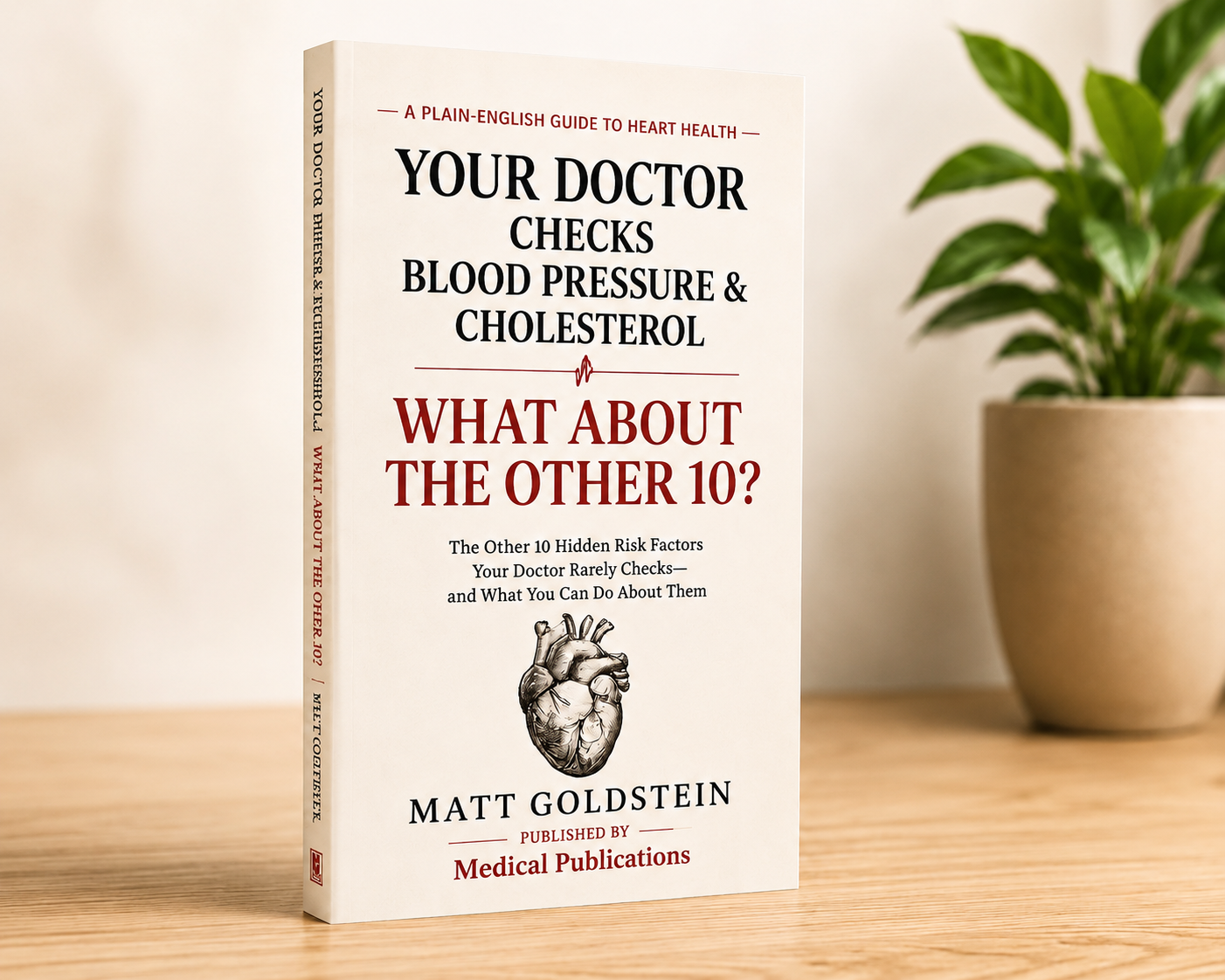
Get Your Free Heart Book
Your Doctor Checks Blood Pressure & Cholesterol: What About the Other 10?
Most heart attacks happen to people whose last checkup came back “fine.” This book covers the 12 risk factors your doctor may not be testing — in plain English, backed by research.
Get the Free Book →*These statements have not been evaluated by the Food and Drug Administration. This article is for educational purposes only and does not constitute medical advice. Always consult your healthcare provider before making changes to your health regimen.*
References
- Nurmohamed NS et al. “First myocardial infarction: risk factors, symptoms, and medical therapy.” European Heart Journal. 2025. PMID: 40605456
- Yusuf S et al. “Effect of potentially modifiable risk factors associated with myocardial infarction in 52 countries (the INTERHEART study): case-control study.” Lancet. 2004;364(9438):937–952. PMID: 15364185
- Littarru GP, Langsjoen P. “Coenzyme Q10 and statins: biochemical and clinical implications.” Mitochondrion. 2007;7 Suppl:S168–74. PMID: 17482884
- Greenland P et al. “Coronary artery calcium score combined with Framingham score for risk prediction in asymptomatic individuals.” JAMA. 2004;291(2):210–215. PMID: 14722147
- Homocysteine Studies Collaboration. “Homocysteine and risk of ischemic heart disease and stroke: a meta-analysis.” JAMA. 2002;288(16):2015–2022. PMID: 12387654
- Ridker PM et al. “C-reactive protein and other markers of inflammation in the prediction of cardiovascular disease in women.” N Engl J Med. 2000;342(12):836–843. PMID: 10733371


