
L-Arginine and L-Citrulline: How These Amino Acids Support Nitric Oxide Production
L-Arginine and L-Citrulline: How These Amino Acids Support Nitric Oxide Production
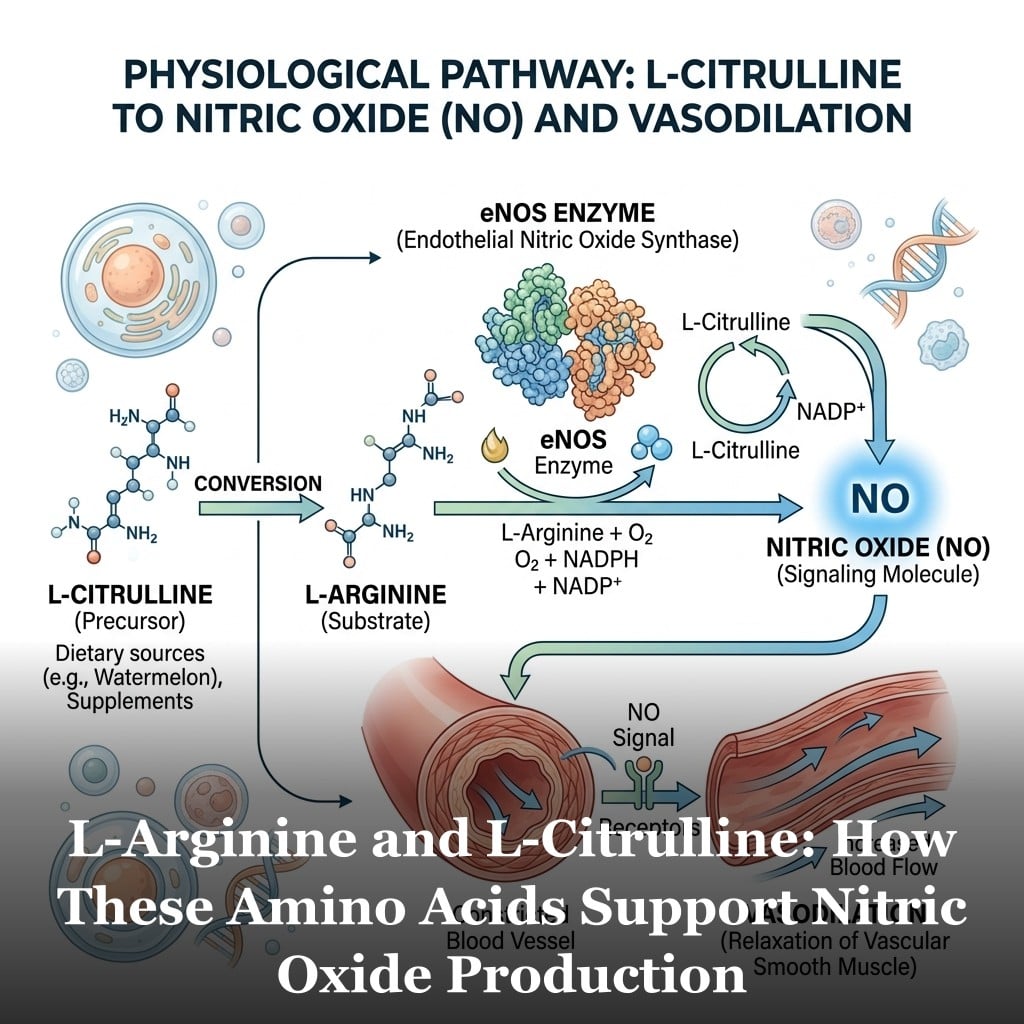
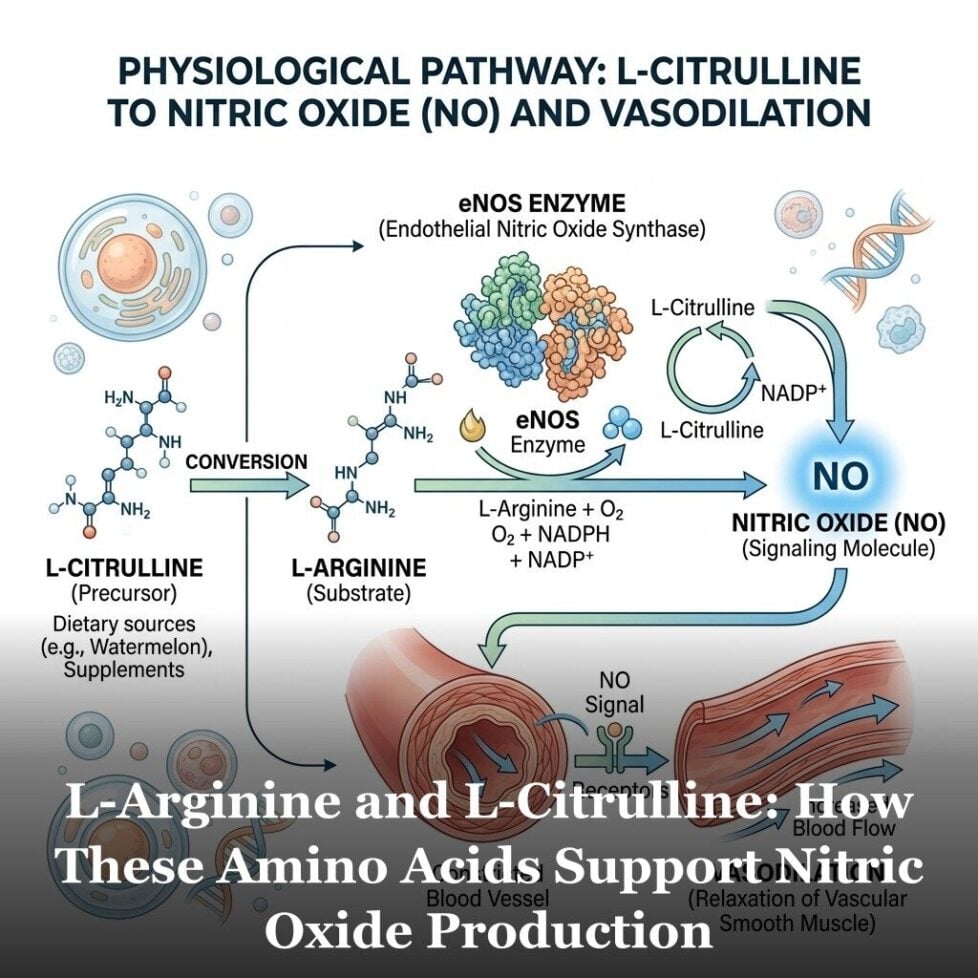
Your body makes nitric oxide from an amino acid called L-arginine. Every time the endothelial enzyme eNOS produces a nitric oxide molecule, it starts with L-arginine as the raw material. And there’s a related amino acid, L-citrulline, that research suggests may actually be more effective than L-arginine supplements for sustaining nitric oxide production over time.
Understanding how these two amino acids work — and why L-citrulline often outperforms direct L-arginine supplementation — gives you a clearer picture of how the NO production system functions and what can support it.
How L-Arginine Becomes Nitric Oxide
L-arginine is a semi-essential amino acid found in protein-rich foods: chicken, turkey, fish, red meat, eggs, dairy, nuts, and seeds. The body can produce it from other amino acids, but dietary intake and endogenous production together determine how much is available to eNOS.
Inside endothelial cells, eNOS catalyzes the reaction: L-arginine + oxygen + NADPH converts to nitric oxide + L-citrulline + NADP+. One L-arginine molecule yields one nitric oxide molecule plus one L-citrulline molecule. The L-citrulline produced in this reaction is a byproduct — and it’s also a precursor to regenerating L-arginine, creating a recycling loop within cells.
The obvious logic is: give the body more L-arginine, and it will produce more nitric oxide. This was the basis for early L-arginine supplement research. But the results have been mixed and sometimes counterproductive, for reasons that reveal something important about how NO production actually works.
Why L-Citrulline May Be More Effective
L-citrulline is found naturally in watermelon (especially the white rind) and in smaller amounts in other foods. Unlike L-arginine, L-citrulline is not metabolized significantly in the gut or liver during absorption. It passes through into systemic circulation relatively intact, then is converted to L-arginine in the kidneys by an enzyme called argininosuccinate synthetase.
This matters for several reasons. First, L-arginine taken orally is substantially broken down in the gut and liver before it reaches the bloodstream, limiting how much actually gets to endothelial cells. L-citrulline bypasses this first-pass metabolism. Second, the conversion of citrulline to arginine in the kidneys provides a sustained, steady supply of arginine to the circulation, rather than the spike-and-crash pattern of direct arginine supplementation.
Multiple clinical studies have compared L-citrulline to L-arginine for supporting NO-dependent measures like flow-mediated dilation and blood pressure. Several have found L-citrulline produces more consistent results. A 2017 review in the British Journal of Clinical Pharmacology concluded that L-citrulline supplementation has more consistent evidence for supporting vascular function than L-arginine supplementation.
Research Context and Appropriate Expectations
The research on L-arginine and L-citrulline for cardiovascular support spans a few decades and includes both supportive and mixed findings. The clearest evidence supports their role in maintaining endothelial NO availability, particularly in populations where NO production is impaired — older adults, those with metabolic disease, or those with documented endothelial dysfunction.
In healthy young adults with already-robust NO production, the benefit of supplementation is less clear. The effects appear most significant where baseline NO production is impaired.
Nitrosigine — a patented complex of arginine silicate — has been studied specifically for its ability to increase plasma arginine and support NO-related measures including flow-mediated dilation. Unlike standard L-arginine, arginine silicate uses a modified form designed to improve bioavailability. Multiple studies have found it supports NO-related measures within 15 minutes and for up to 6 hours.
For the full picture of how the nitric oxide pathways work together — including the dietary nitrate pathway covered in the next article — see our overview of nitric oxide and heart health. And for how these pieces fit into the broader cardiovascular picture, see the 12 cardiovascular risk factors.
Frequently Asked Questions
What is a typical supplemental dose of L-citrulline?
Studies on cardiovascular support have typically used 3-6 grams of L-citrulline malate daily. Pure L-citrulline studies have used 3-6g as well. These are the doses used in most of the research showing vascular effects. Watermelon-derived doses require much larger food quantities to reach these levels. As always, discuss supplement use with your doctor, especially if you have existing cardiovascular conditions.
Is L-citrulline safe?
L-citrulline has a good safety profile in research studies up to doses of 15g/day, with most studies using 3-6g. The most commonly reported side effect at higher doses is mild gastrointestinal discomfort. People taking medications that affect blood pressure or those with kidney disease should consult their doctor before supplementing, as L-citrulline’s effects on vasodilation could interact with these conditions.
Do L-arginine and L-citrulline work differently from dietary nitrates?
Yes. L-arginine and L-citrulline support the enzymatic NO pathway — feeding the eNOS enzyme in endothelial cells. Dietary nitrates (from beets, arugula, spinach) support the nitrate-nitrite-NO pathway, which uses oral bacteria to convert nitrates to nitrite and then to NO in tissues. These are two completely separate biochemical routes to NO production. They can complement each other.
What is Nitrosigine and how is it different from regular L-arginine?
Nitrosigine (arginine silicate inositol) is a patented complex of L-arginine bonded to silicate. The silicate component is believed to protect L-arginine from first-pass degradation and improve bioavailability. Studies have found Nitrosigine raises plasma arginine levels more effectively than equivalent doses of standard L-arginine and sustains elevated levels longer. These statements have not been evaluated by the FDA.
Get Your Free Heart Book
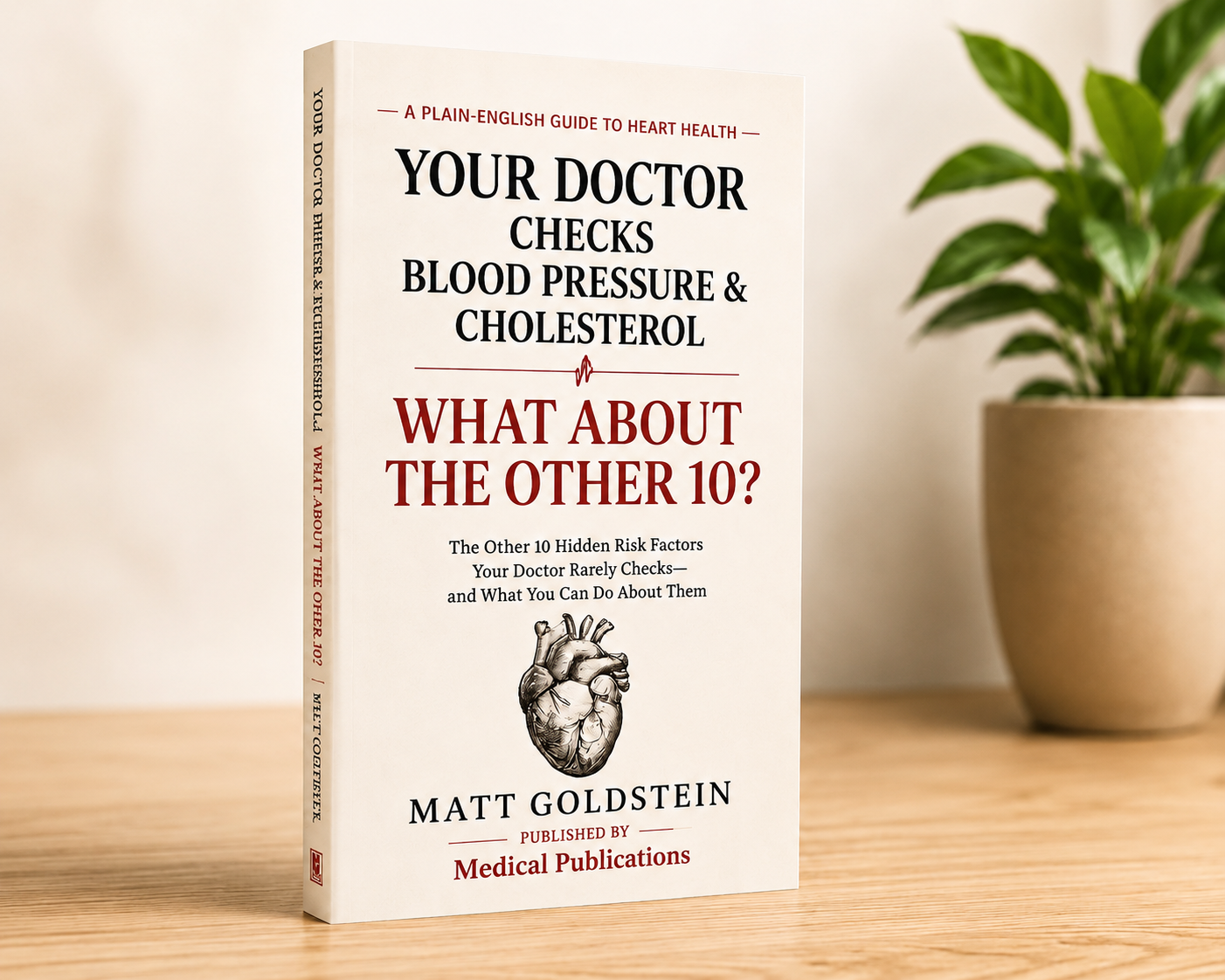
Your Doctor Checks Blood Pressure & Cholesterol: What About the Other 10?
Most heart attacks happen to people whose last checkup came back “fine.” This book covers the 12 risk factors your doctor may not be testing — in plain English, backed by research.
Get the Free Book →* These statements have not been evaluated by the Food and Drug Administration. This product is not intended to diagnose, treat, cure, or prevent any disease.


