

Low Testosterone and Heart Health: What the Research Is Starting to Show
Low Testosterone and Heart Health: What the Research Is Starting to Show
Testosterone is primarily thought of as a sex hormone, but it does considerably more than regulate reproduction. Research over the past two decades has associated low testosterone levels — in both men and women — with a cluster of cardiovascular risk factors including visceral fat accumulation, insulin resistance, unfavorable lipid profiles, and arterial stiffness. Here’s what the research is showing and what it means practically.

Lifestyle factors, chronic stress, sleep deprivation, and metabolic dysfunction all suppress testosterone production. And low testosterone, in turn, may worsen the same cardiovascular risk factors that caused the suppression in the first place.
What Does Testosterone Actually Do in the Body?
Testosterone belongs to a class of hormones called androgens. In men, the testes produce most of it. In women, the ovaries and adrenal glands produce smaller but still physiologically important amounts.
Beyond its role in sexual development and reproductive function, testosterone has wide-ranging effects throughout the body. It supports muscle protein synthesis, which is why low testosterone is associated with loss of lean mass and increased fat, particularly visceral fat (the fat packed around internal organs). It maintains bone density, influences mood and cognitive function, and plays a role in red blood cell production.
Cardiovascular relevance comes from several directions. Testosterone affects insulin signaling, lipid metabolism, endothelial function, and inflammatory pathways — all of which are directly tied to heart health. This is why researchers began looking more carefully at what happens when testosterone drops below a healthy range.
What Does “Low Testosterone” Actually Mean — and How Do You Know?
In men, the clinical threshold most commonly used is a total testosterone level below 300 ng/dL, measured from a morning blood draw (testosterone peaks in the early hours and declines through the day). A single low reading is typically confirmed with a second test before a clinical diagnosis is made.
But numbers alone don’t tell the whole story. A man at 295 ng/dL who feels fine and has no symptoms is different from a man at 295 ng/dL who has fatigue, difficulty building muscle, low libido, and brain fog. Symptoms matter alongside lab values.
For women, the picture is more complex. Women’s testosterone levels are normally much lower (roughly 15 to 70 ng/dL), and there’s no equivalent consensus clinical threshold. Low testosterone in women is recognized as a clinical concern in some contexts — particularly after surgical menopause — but the diagnostic standards are still developing.
Estimates vary depending on how it’s defined, but studies suggest that roughly 2-4% of men have clinically low testosterone overall — a number that rises substantially with age, metabolic syndrome, and obesity. Some estimates suggest that by age 70, 20-30% of men may have total testosterone below 300 ng/dL.
How Is Testosterone Connected to Cardiovascular Risk?
The testosterone-cardiovascular link works in multiple directions, which is part of what makes it scientifically interesting and clinically complicated.
Observational studies have associated low testosterone in men with higher rates of visceral adiposity — the accumulation of fat around internal organs. Visceral fat is metabolically active and pro-inflammatory. It drives insulin resistance, raises triglycerides, and lowers HDL cholesterol. It also converts testosterone to estrogen through an enzyme called aromatase, which can further suppress testosterone levels and create a reinforcing cycle.
Population research has also linked low testosterone to unfavorable changes in lipid profiles, higher rates of metabolic syndrome, and measurable increases in arterial stiffness — a marker of vascular aging that independently predicts cardiovascular events.1
Testosterone appears to have vasodilatory effects, meaning it helps blood vessels relax and open. Some research suggests that low testosterone may reduce nitric oxide production, a key molecule for maintaining arterial flexibility. This could help explain the link between low testosterone and arterial stiffness.
Why This Relationship Runs in Both Directions
Here is where the research gets particularly important to understand. Cardiovascular disease and its underlying risk factors also suppress testosterone. It’s not a one-way street.
Obesity, particularly central obesity, suppresses the hypothalamic-pituitary-gonadal axis — the hormonal chain of command that tells the testes to produce testosterone. Chronic inflammation, which is a hallmark of metabolic syndrome and cardiovascular disease, suppresses testosterone production directly. Chronic stress elevates cortisol, which has a well-documented inhibitory effect on testosterone synthesis.2
This bidirectional relationship means that addressing cardiovascular risk factors may itself support healthier testosterone levels, and that supporting testosterone within a healthy range may reduce cardiovascular risk factors. The two systems are entangled.

The Sleep-Testosterone Connection That Most People Overlook
Of all the lifestyle factors linked to testosterone, sleep may be the most underappreciated. The majority of testosterone production happens during sleep — specifically during REM and slow-wave sleep stages. Even one week of sleeping five hours per night instead of eight has been shown to reduce testosterone levels in young healthy men by 10-15% in clinical research.3
Sleep apnea compounds this. Obstructive sleep apnea interrupts sleep architecture and causes repeated oxygen drops throughout the night. It’s associated with significantly lower testosterone levels, and it’s far more common than most people realize — a substantial portion of adults with untreated sleep apnea have no idea they have it.
If you’re prioritizing everything except sleep, the research suggests you’re leaving a lot on the table — not just for hormone health but for the full spectrum of cardiovascular risk factors.
What Does Research Associate with Healthy Testosterone Levels?
Several factors consistently come up in the research on maintaining or supporting healthier testosterone levels across the lifespan.
Resistance training has one of the strongest evidence bases. Regular weightlifting is consistently associated with healthier testosterone levels compared to sedentary behavior. The mechanism involves multiple pathways, including reduced visceral fat, improved insulin sensitivity, and direct stimulatory effects on hormone production.
Zinc and vitamin D both show up repeatedly in research on testosterone. Zinc is required for testosterone synthesis and is present in testicular tissue at high concentrations. Deficiency is associated with lower testosterone levels. Vitamin D receptors are found in testicular cells, and observational research has consistently associated higher vitamin D levels with higher testosterone.4
Maintaining a healthy body weight is important specifically because visceral fat drives aromatase activity — the conversion of testosterone to estrogen. Weight loss in men with obesity is associated with meaningful increases in testosterone levels.
Managing chronic stress matters through the cortisol pathway. Elevated cortisol chronically competes with and suppresses testosterone at the level of production and cellular action.

What About Testosterone Therapy — Is It Safe and Should You Consider It?
This is where the conversation gets more nuanced and more personal, and where the research is still evolving.
Earlier studies from the early 2010s raised concerns about increased cardiovascular risk from testosterone replacement therapy (TRT). This created significant controversy and dampened enthusiasm for TRT in men with cardiovascular disease. More recent and larger studies have painted a somewhat different picture.
The TRAVERSE trial, published in 2023, was the largest randomized controlled trial of testosterone therapy in men with hypogonadism and high cardiovascular risk. It found no significant increase in major adverse cardiovascular events — heart attack, stroke, or cardiovascular death — compared to placebo.5 It did find a higher rate of atrial fibrillation and pulmonary embolism in the testosterone group, which are important considerations for individual patients.
What this means in practice: testosterone therapy is not universally dangerous, but it’s not universally safe or appropriate either. It’s a decision that requires a thorough conversation with a physician who can weigh the potential benefits against your specific risk profile. The research is complex enough that this is not an area for self-directed experimentation.
A Note for Women: Testosterone Matters Here Too
Much of the research and clinical conversation around testosterone focuses on men, but women have testosterone too — just at much lower levels. In women, testosterone contributes to bone density, muscle maintenance, libido, and energy levels.
Low testosterone in women is most commonly seen after surgical menopause (removal of the ovaries) and is associated with fatigue, reduced muscle mass, and low libido. The cardiovascular implications in women are less well studied than in men, but the same metabolic connections — visceral fat, insulin resistance, inflammation — are relevant across sexes.
Women who have concerns about testosterone levels should seek out a physician knowledgeable in women’s hormonal health, as the diagnostic standards and treatment approaches differ substantially from the male framework.

*These statements have not been evaluated by the Food and Drug Administration. This product is not intended to diagnose, treat, cure, or prevent any disease.
Frequently Asked Questions
What’s considered “low” testosterone, and how do you find out if yours is low?
In men, a total testosterone below 300 ng/dL is the most commonly used clinical threshold, but symptoms matter alongside the number. The test is a morning blood draw (testosterone peaks early in the day). One low reading is usually confirmed with a second test before any diagnosis is made. Women’s testosterone levels are normally much lower, and what counts as “low” in women is evaluated through a different clinical lens.
Why do testosterone levels tend to decline with age, and is that inevitable?
In men, total testosterone typically drops about 1-2% per year starting in the early 30s, driven by changes in testicular output and the hormonal signaling system. But the rate varies enormously between individuals. Lifestyle factors — inadequate sleep, excess visceral fat, chronic stress, physical inactivity — can significantly accelerate the decline. Addressing those factors doesn’t stop the biological clock, but research suggests it meaningfully moderates the rate of decline.
Is testosterone therapy safe for men with heart disease or cardiovascular risk factors?
This is evolving territory. Earlier studies raised concerns, but the TRAVERSE trial (2023) — the largest randomized trial of testosterone therapy in men with hypogonadism and cardiovascular risk — did not find a significant increase in major cardiovascular events. However, the trial did find higher rates of atrial fibrillation and pulmonary embolism in the testosterone group. This is a decision that requires an individualized conversation with a physician who knows your full risk profile. There’s no blanket answer.
Do women need to worry about testosterone levels too?
Women have testosterone too — at much lower levels — and it plays a real role in bone density, muscle mass, energy, and libido. Low testosterone in women is most commonly a concern after surgical menopause. The cardiovascular research in women is less developed than in men, but the metabolic connections are relevant across sexes. Women with concerns should look for a physician who specializes in women’s hormonal health, as the diagnostic framework differs from the male approach.
What lifestyle changes have the most research behind them for naturally supporting healthy testosterone levels?
Sleep is the most underrated factor — the majority of testosterone production happens during sleep, and even short-term deprivation measurably lowers levels. Regular resistance training has strong supporting evidence. Maintaining a healthy body weight reduces the visceral fat that drives testosterone-to-estrogen conversion. Adequate zinc and vitamin D are nutritionally important. And managing chronic stress helps keep cortisol from suppressing the hormonal signaling chain that drives testosterone production.
Pulling It Together: Testosterone and the Broader Cardiovascular Picture
Testosterone isn’t a magic number to chase or a simple fix for cardiovascular risk. It’s one piece of a complex system that includes sleep quality, metabolic health, body composition, stress levels, and nutrient status — all of which are also directly relevant to heart health.
If you’re in the 40-70 age range and haven’t had a hormone panel done recently, it’s worth asking your doctor about. Not because low testosterone is always a crisis, but because knowing where you stand gives you more information to work with. And the lifestyle factors that support healthy testosterone — sleep, resistance training, healthy body weight, stress management — overlap almost perfectly with the lifestyle factors that support cardiovascular health.
For the full framework on how cardiovascular risk factors connect, the guide to 12 cardiovascular risk factors is a good place to start. If insulin resistance and metabolic function are part of your picture, the article on blood sugar and heart health goes deeper. And if arterial stiffness is something your doctor has mentioned, the article on arterial stiffness explains what’s happening inside the vessels and why it matters.
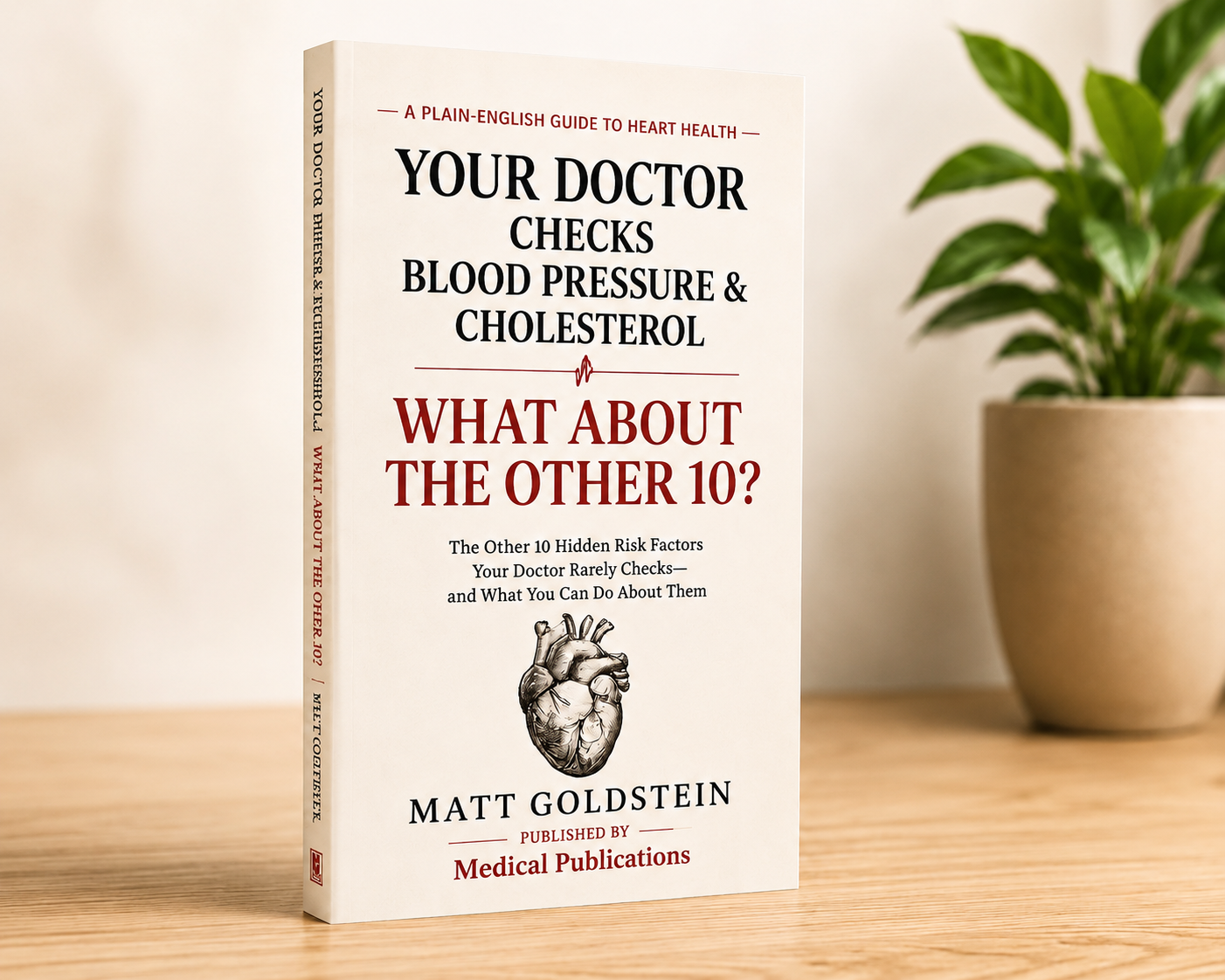
Get Your Free Heart Book
Your Doctor Checks Blood Pressure & Cholesterol: What About the Other 10?
Most heart attacks happen to people whose last checkup came back “fine.” This book covers the 12 risk factors your doctor may not be testing — in plain English, backed by research.
*These statements have not been evaluated by the Food and Drug Administration. This product is not intended to diagnose, treat, cure, or prevent any disease. This article is for educational purposes only and does not constitute medical advice. Always consult your healthcare provider before making changes to your health regimen.
References
- Dhindsa S, et al. “Testosterone concentrations in diabetic and nondiabetic obese men.” Diabetes Care. 2010;33(6):1186–1192.
- Björntorp P. “Do stress reactions cause abdominal obesity and comorbidities?” Obes Rev. 2001;2(2):73–86.
- Leproult R, Van Cauter E. “Effect of 1 week of sleep restriction on testosterone levels in young healthy men.” JAMA. 2011;305(21):2173–2174.
- Pilz S, et al. “Effect of vitamin D supplementation on testosterone levels in men.” Horm Metab Res. 2011;43(3):223–225.
- Lincoff AM, et al. “Cardiovascular Safety of Testosterone-Replacement Therapy.” N Engl J Med. 2023;389(2):107–117.
- Traish AM. “Testosterone and weight loss: the evidence.” Curr Opin Endocrinol Diabetes Obes. 2014;21(5):313–322.
- Wu FC, et al. “Identification of late-onset hypogonadism in middle-aged and elderly men.” N Engl J Med. 2010;363(2):123–135.


