
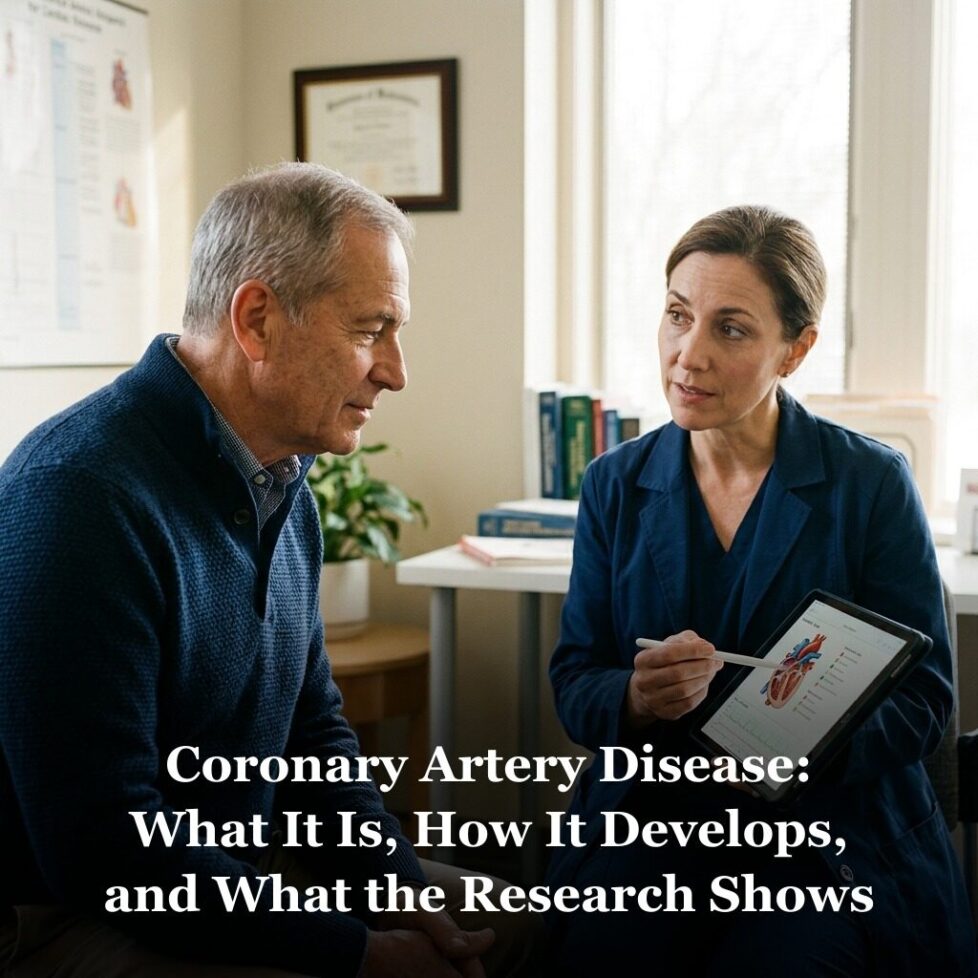
Coronary Artery Disease: What It Is, How It Develops, and What the Research Shows About Prevention
Coronary Artery Disease: What It Is, How It Develops, and What the Research Shows About Prevention
Coronary artery disease (CAD) is the leading cause of death in the United States, responsible for roughly one in five deaths. It develops slowly over decades, often with no symptoms at all, until the arteries supplying blood to the heart become so narrowed that something gives way. Here’s how it actually works — and what the research consistently shows about the factors that accelerate or slow its progression.

What Is Coronary Artery Disease — and Why Does It Matter So Much?
Coronary artery disease is atherosclerosis — the buildup of plaque inside artery walls — occurring specifically in the coronary arteries. These are the arteries that wrap around the heart and supply its muscle with oxygen-rich blood. The heart is one of the most metabolically active organs in the body. It never rests. It needs a constant, reliable blood supply to keep beating.
When the coronary arteries narrow due to plaque buildup, the heart muscle gets less blood than it needs, particularly during exertion. When a plaque ruptures and a clot forms, the artery can become blocked entirely. That’s a heart attack — a portion of the heart muscle is cut off from blood and begins to die.
This is the mechanism behind roughly half a million American deaths every year. Understanding it doesn’t require a medical degree. It requires a clear picture of how the process unfolds.
How Does Coronary Artery Disease Develop Over Time?
The process begins with damage to the endothelium — the thin inner lining of the arteries. Endothelial damage can be caused by high blood pressure pushing against vessel walls, elevated LDL cholesterol particles penetrating the lining, blood sugar imbalances, inflammation, smoking, and other factors.
Once the endothelium is damaged, LDL cholesterol can enter and get trapped beneath it. White blood cells rush to the scene and try to clear out the cholesterol, but in doing so they become foam cells — the beginning of a fatty streak. Over time, this process builds into a plaque: a mixture of cholesterol, cellular debris, and fibrous material.
As plaques grow, they narrow the artery. But narrowing isn’t the only problem. Some plaques are structurally unstable — they have a thin fibrous cap over a soft, lipid-rich core. When one of those plaques ruptures, the body responds by forming a clot at the rupture site. If that clot becomes large enough to block the artery, blood flow stops. Heart muscle dies.
Why Do So Many People Have No Symptoms Until a Heart Attack Happens?
This is the part that surprises most people. The coronary arteries can narrow by 50% or even 70% before causing noticeable symptoms during normal daily activity. The heart has some built-in compensation — it can route blood through collateral vessels — but the threshold for symptomatic CAD is high.
A plaque that ruptures and causes a heart attack is often not even the most visually dramatic plaque on an imaging scan. Smaller, softer, less calcified plaques can be more prone to rupture than the large, stable, heavily calcified ones. This is one reason that coronary angiography alone doesn’t tell the full story.
Silent CAD — significant disease with no symptoms — is more common than most people assume. It’s part of why risk factor management matters even (especially) when you feel fine.
What Risk Factors Does Research Most Consistently Link to CAD?
This is where the 12 cardiovascular risk factors framework becomes particularly useful. CAD is not caused by one thing. It’s the downstream result of multiple converging factors, and most of them are at least partially addressable.
The most consistently supported risk factors in the research include elevated LDL cholesterol — particularly the small dense LDL particles that penetrate the arterial wall most readily. High blood pressure accelerates endothelial damage. Smoking causes direct injury to the endothelium, promotes inflammation, and raises LDL oxidation. Diabetes and insulin resistance create a particularly damaging combination of inflammation, glycation, and dyslipidemia.
Inflammatory markers matter too. Elevated homocysteine is associated with endothelial injury in population research. High-sensitivity CRP reflects systemic inflammation that accelerates plaque formation. These are often absent from a basic annual checkup but provide meaningful information about CAD risk.
Physical inactivity, obesity, chronic stress, poor sleep, and excess alcohol are all linked to CAD risk through multiple pathways. They affect blood pressure, inflammation, lipid profiles, and insulin sensitivity simultaneously.

What Is Coronary Calcium Scoring and Who Should Know About It?
Coronary artery calcium (CAC) scoring is a low-dose CT scan that detects and measures calcified plaque in the coronary arteries. It’s one of the most useful tools available for finding silent CAD before symptoms develop.
A score of zero — no detectable calcified plaque — is associated with a very low near-term cardiac event risk, even in people with other risk factors. A higher score indicates more calcification and suggests a higher burden of disease. The results can meaningfully change how doctors approach risk management for a given patient.
CAC scoring isn’t right for everyone. It’s most useful for adults with intermediate cardiovascular risk — people who aren’t already clearly high-risk or clearly low-risk. Guidelines generally suggest it’s worth discussing with your doctor if you’re in your 40s to 70s and your risk category is uncertain. It exposes you to a small amount of radiation (about the same as a mammogram) and costs between $100 and $400, often not covered by insurance.
If your score comes back elevated, it’s not a death sentence. It’s information. Knowing you have calcified plaque changes how aggressively you and your doctor pursue every other modifiable risk factor.

What Does the Research Say About Slowing or Preventing Coronary Artery Disease?
The evidence base here is deep and consistent across decades of research. A handful of interventions show up again and again in population studies and clinical trials.
Not smoking — or quitting — has one of the strongest evidence bases of any cardiovascular intervention. Smoking accelerates endothelial damage, raises oxidized LDL, promotes clot formation, and reduces HDL cholesterol. The risk begins dropping within months of quitting.
Regular physical activity is associated with lower CAD rates across virtually every population studied. Exercise improves blood pressure, lipid profiles, insulin sensitivity, and vascular function. Walking briskly for 30 minutes most days moves the needle.
Diet patterns matter. The Mediterranean dietary pattern — emphasizing vegetables, fruits, legumes, whole grains, fish, and olive oil — has more cardiovascular outcome data behind it than almost any other dietary approach. It’s not a magic formula, but the pattern is consistently associated with lower CAD risk in long-term studies.1
Blood pressure and cholesterol management are where conventional medicine has the most robust tools, including statins and antihypertensives. These medications have strong outcome data — actual reductions in heart attacks and deaths — and lifestyle factors complement rather than replace them for people who need pharmacologic support.
Understanding nitric oxide and its role in vascular health adds another layer to this picture, as does keeping an eye on blood sugar and heart health, which is closely tied to the inflammatory pathways that drive plaque formation.
The Conventional Approach and What Complements It
Statins remain the most studied cholesterol-lowering medication and have consistent evidence for reducing cardiovascular events in high-risk patients. ACE inhibitors and ARBs address blood pressure while also reducing arterial stiffness. Aspirin therapy has become more nuanced in recent guidelines — it’s no longer recommended for primary prevention in most people but remains important for secondary prevention in those who’ve already had a cardiac event.
These aren’t alternatives to lifestyle changes. They work alongside them. A person managing their blood pressure with medication who also exercises, eats well, doesn’t smoke, and manages stress has a meaningfully better risk profile than someone relying on medication alone.
The research is also exploring what HDL cholesterol actually does beyond simply being “the good one” — it turns out HDL function matters as much as HDL quantity. And platelet activity and blood clots represent another layer of the acute event risk that’s distinct from atherosclerosis itself.

*These statements have not been evaluated by the Food and Drug Administration. This product is not intended to diagnose, treat, cure, or prevent any disease.
Frequently Asked Questions
What’s the difference between a heart attack and coronary artery disease?
Coronary artery disease is the slow, decades-long buildup of plaque in the coronary arteries. A heart attack is the acute event — usually a plaque rupture followed by a blood clot that blocks an artery, cutting off blood supply to part of the heart muscle. CAD is the underlying condition. A heart attack is what can happen when that condition reaches a critical point.
Can you have coronary artery disease for years without knowing it?
Yes — this is one of the most important things to understand about CAD. The coronary arteries can narrow significantly over 20 or 30 years without producing noticeable symptoms. For many people, the first sign that something is wrong is a heart attack or a finding on an imaging test they got for another reason. This is precisely why proactive screening tools like coronary calcium scoring exist.
What is a coronary calcium score and should you ask your doctor about it?
A coronary artery calcium (CAC) score is a brief, low-dose CT scan that detects calcified plaque in the coronary arteries. A score of zero is very reassuring — it suggests little to no detectable plaque. Higher scores indicate more disease and help your doctor make more precise decisions about risk management. It’s worth discussing if you’re between 40 and 75 years old and your cardiovascular risk level is unclear from standard bloodwork alone.
Does coronary artery disease run in families, and how much does genetics actually matter?
Family history is a real risk factor. Having a first-degree relative (parent or sibling) who had a heart attack before age 55 (male) or 65 (female) elevates your risk. But genetics isn’t destiny. Large population studies consistently show that lifestyle factors account for a substantial portion of CAD risk even in people with a strong family history. Knowing your history is valuable — it raises the stakes for everything else you can control.
If you’ve already been diagnosed with CAD, can lifestyle changes still make a difference?
The research here is genuinely encouraging. People who make meaningful lifestyle changes after a CAD diagnosis — regular exercise, Mediterranean-style diet, quitting smoking, better blood pressure control — consistently show slower disease progression and better outcomes than those who don’t. Lifestyle changes don’t replace medication for people who need it, but the combination outperforms either approach alone.
Putting It All Together: CAD Is a System-Level Problem That Requires a System-Level Response
The most important thing to take away from understanding coronary artery disease is that it’s not caused by one bad number on a blood test. It’s the cumulative result of multiple risk factors operating over years or decades. Blood pressure, cholesterol, inflammation, blood sugar, smoking, sleep, exercise, and diet all feed into the same underlying process.
That’s actually good news. Because it means there are many points of intervention. Each risk factor you bring under control reduces your overall exposure. You don’t have to be perfect. You have to make consistent progress on the things that matter most.
For the full picture of what those interconnected risk factors look like, the guide to 12 cardiovascular risk factors covers all of them in plain English. If lipid-related risk is part of your picture, the articles on small dense LDL cholesterol and homocysteine go deeper on two of the most underappreciated ones. And the overview of atherosclerosis explains the plaque formation process in more detail.
Get the Free Heart Health Guide
A plain-English overview of the 12 cardiovascular risk factors — what they are, how they connect, and what to ask your doctor.
Download Free Guide →*These statements have not been evaluated by the Food and Drug Administration. This product is not intended to diagnose, treat, cure, or prevent any disease. This article is for educational purposes only and does not constitute medical advice. Always consult your healthcare provider before making changes to your health regimen.
References
- Estruch R, et al. “Primary prevention of cardiovascular disease with a Mediterranean diet supplemented with extra-virgin olive oil or nuts.” N Engl J Med. 2018;378(25):e34.
- Libby P, et al. “Atherosclerosis.” Nat Rev Dis Primers. 2019;5(1):56.
- Arnett DK, et al. “2019 ACC/AHA Guideline on the Primary Prevention of Cardiovascular Disease.” Circulation. 2019;140(11):e596–e646.
- Agatston AS, et al. “Quantification of coronary artery calcium using ultrafast computed tomography.” J Am Coll Cardiol. 1990;15(4):827–832.
- Yusuf S, et al. “Effect of potentially modifiable risk factors associated with myocardial infarction in 52 countries (the INTERHEART study).” Lancet. 2004;364(9438):937–952.
- Grundy SM, et al. “2018 AHA/ACC/AACVPR/AAPA/ABC/ACPM/ADA/AGS/APhA/ASPC/NLA/PCNA Guideline on the Management of Blood Cholesterol.” J Am Coll Cardiol. 2019;73(24):e285–e350.


